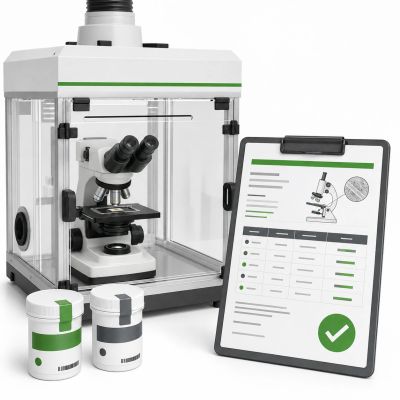
Asbestos Sample Testing
The only way to confirm whether a suspect material contains asbestos is through representative sampling and laboratory analysis. We coordinate competent on-site sampling and UKAS-accredited testing of building materials, soils and other suspect materials, with clear reporting.
On-Site Sampling
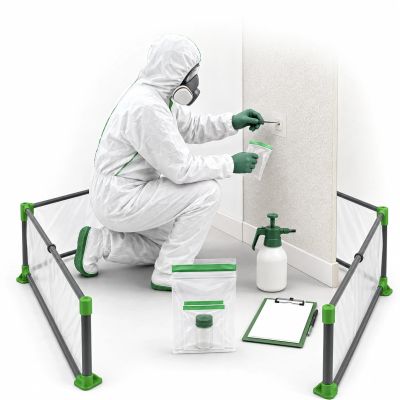
Sampling of suspect bulk materials from internal and external areas of domestic, commercial and industrial properties.
Asbestos in Soils & Materials
Sampling and laboratory analysis of soils and other materials suspected of containing asbestos.
UKAS-Accredited Analysis
Identification of asbestos fibres by a UKAS-accredited laboratory working to ISO/IEC 17025.
On-Site Sampling
On-site sampling is suitable where one or more specific materials need to be tested—for example, before localised maintenance or repair work, following the discovery of an unexpected material or where existing asbestos information is incomplete.
SAMPLE COLLECTION
Sampling is completed by a suitably trained and competent asbestos professional. The material and surrounding area are assessed before a representative sample is carefully collected using controlled methods designed to minimise fibre release. The sampling point is cleaned & made good following collection. Each sample is securely packaged, individually labelled and recorded against its material description and location before being submitted for laboratory analysis.
RESULTS AND LIMITATIONS
Samples are analysed by a UKAS-accredited laboratory working to ISO/IEC 17025. The analytical report confirms whether asbestos was detected and identifies any asbestos fibre types found.
A sample result only represents the particular material and location tested. It does not confirm that other materials or areas of the property are asbestos-free. Where wider information is required, an appropriate asbestos survey should be completed.
Asbestos in Soils & Materials
Asbestos may be present within soil, made ground, demolition arisings, rubble, recycled aggregates and other loose materials, particularly on previously developed or demolished sites. Contamination may consist of visible fragments of asbestos-containing material, fibre bundles or fine dispersed fibres that cannot be identified during an ordinary visual inspection.
SAMPLING AND TESTING
As Asbestos can be unevenly distributed, sample locations, depths and material descriptions should be carefully recorded. An individual result only represents the sample tested and should not be treated as confirmation that the wider site is asbestos-free.
LABORATORY ANALYSIS
Qualitative identification, commonly described as Stage 1, determines whether asbestos is detected and identifies the fibre types present using recognised microscopy techniques.
Where asbestos is identified, gravimetric quantification—commonly described as Stage 2—may be used to separate and weigh visible asbestos-containing material and fibre bundles.
Where required, free or dispersed fibre analysis—commonly described as Stage 3—uses additional sample preparation and fibre counting to estimate fine asbestos fibres that may not be adequately represented by the gravimetric result. UKAS asbestos laboratory guidance

UKAS-Accredited Analysis & Reporting
All samples are submitted to a laboratory holding UKAS accreditation to ISO/IEC 17025 for the specific asbestos analysis required, particularly where asbestos-in-soil identification or quantification is requested.
LABORATORY ANALYSIS
Each sample is assigned a unique reference and examined under controlled laboratory conditions by a trained and competent analyst. The analysis determines whether asbestos is detected and identifies the asbestos fibre type or types present. Soil and other loose materials may require additional qualitative or quantitative analysis, this may also include a water absorption test used to determine the material type when looking at potential AIB.
WHAT THE REPORT SHOWS
The analytical report records the project and sample references, material description and sampling location where provided, the analytical method and the results obtained. For ordinary bulk materials, the result will normally state either “no asbestos detected” (NAD), or identify the asbestos fibre types found. Soil reports may also include gravimetric or free-fibre quantification where these tests have been specifically requested.
UNDERSTANDING YOUR RESULTS
A laboratory result relates only to the sample submitted. “No asbestos detected” does not confirm that the entire material, property or site is asbestos-free. Results should be considered alongside the sampling record, asbestos survey, site investigation information and proposed work. JD Environmental Solutions coordinates the sampling, appropriate laboratory instruction and delivery of the completed analytical documentation.
Where an asbestos-containing board cannot be reliably distinguished from asbestos cement, a water-absorption test may be requested. Under the HSE method, absorption below 30% supports classification as asbestos cement, while absorption above 30% indicates that the material should be treated as a higher-risk product for which licensed work is required, such as AIB.